
 ,
,


As soon as one number needs to ring on several devices, or several people have different roles, telephony becomes a small routing problem. A PBX can make that manageable, but only when the rules remain understandable.
Start with the desired call flow: who should be reachable when, what happens when nobody answers, and which numbers should be shown on outgoing calls?
No. Some providers support multiple registrations or simple forwarding. A PBX becomes more useful when you want to combine extensions, queues, groups, time schedules, menus or several external numbers.
A ring group sends one incoming call to several devices or extensions, either at the same time or in a defined order. Also define what happens if nobody answers.
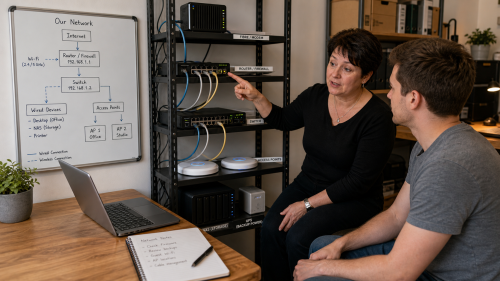
Keep a diagram of numbers, extensions, devices and rules. Give functions names that match their real role and remove old forwarding rules or accounts as soon as they are no longer used.
In a limited number of situations it can, through the separate ACM-registered operation that uses the same name ASK-Solutions. Current explanation and prices are on the information page about independence and technical continuity.
Copyright © 2026, ASK-Solutions


